
NOTE: Published a few days late.
| In this week’s newsletter, explore the progress of NASA’s NEO Surveyor, the agency’s first infrared space telescope designed specifically to detect potentially hazardous asteroids and comets; find out how to watch the launch of NASA’s SpaceX CRS-34 commercial resupply services mission to the International Space Station; and learn how conservationists are turning to NASA-funded research to understand the migration journeys of golden eagles. Plus, more stories you might have missed. |
| SCIENCE Finding Asteroids Before They Find Us  |
| NASA’s Near-Earth Object (NEO) Surveyor — the agency’s first infrared space telescope designed specifically to detect potentially hazardous asteroids and comets — is now in integration and testing at Utah State University’s Space Dynamics Laboratory in Logan, Utah. Targeting a launch no earlier than September 2027, teams across the United States are assembling the spacecraft’s components and developing the software needed to process the huge quantity of data the telescope will produce. The NEO Surveyor is designed to help advance NASA’s planetary defense efforts to discover and characterize most of the potentially hazardous asteroids and comets that come within 30 million miles of Earth’s orbit. These are collectively known as near-Earth objects, or NEOs. After launch, NEO Surveyor will carry out a five-year baseline survey to find at least two-thirds of the near-Earth objects larger than 460 feet. These are the objects large enough to cause major regional damage in the event of an Earth impact. By using two heat-sensitive infrared imaging channels, NEO Surveyor can make accurate measurements of NEO sizes and gain valuable information about their composition, shapes, rotational states, and orbits. NEAR-EARTH OBJECT SURVEYOR |
 | THE UNIVERSE The Hunt for Elusive Stars Astronomers have long recognized that neutron stars — the ultra‑dense stellar cores left behind after massive stars explode — should be widespread in the Milky Way, yet most remain invisible. Using galaxy simulations and anticipated data from NASA’s Nancy Grace Roman Space Telescope, researchers show the mission could identify and characterize dozens of these isolated neutron stars. ROMAN SPACE TELESCOPE |
| HUMANS IN SPACE Science Launching NASA and SpaceX are targeting 7:16 p.m. EDT Tuesday, May 12, for the next commercial resupply services mission to the International Space Station. In addition to carrying cargo for the crew aboard the orbiting laboratory, a SpaceX Dragon spacecraft will deliver several new experiments. These include a study evaluating how accurately Earth‑based simulators reproduce microgravity; a wood‑based bone scaffold that could lead to new treatments for fragile‑bone conditions; and equipment to investigate how red blood cells and the spleen change during spaceflight. NASA’S SPACEX CRS-34 COVERAGE |  |
 THE UNIVERSE Possible New Worlds A study using data from NASA’s Transiting Exoplanet Survey Satellite, or TESS, has uncovered more than two dozen candidate exoplanets in systems where two stars eclipse each other. To date, TESS has discovered 885 confirmed exoplanets and identified more than 7,900 candidates, most found when planets pass in front of their stars and cause a small dip in brightness. The mission also observes tens of thousands of eclipsing binary stars — pairs of stars that alternately block each other from view. LEARN MORE |  HUMANS IN SPACE Checking In With CHAPEA The four crew members of NASA’s CHAPEA (Crew Health and Performance Exploration Analog) mission recently passed 200 days inside their simulated Mars habitat. Now more than halfway through the mission, the crew continues to provide NASA with valuable data on how humans adapt to isolation, confinement, and limited resources — key challenges for future exploration of the Moon and Mars. LEARN MORE |
| More NASA News |
 | After a recent count, NASA Citizen Science reports that more than 650 volunteers have co‑authored peer‑reviewed research papers alongside project scientists. These citizen scientists have made remarkable contributions — spotting comets, gamma‑ray bursts, and brown dwarfs in space‑telescope data; observing auroras, sprites, and noctilucent clouds from the ground; using backyard telescopes to study exoplanets or cell phones to report mosquito‑breeding habitats; and even using ham radios to investigate Earth’s ionosphere. |
 | A university‑designed small spacecraft, developed through NASA, is helping pave the way for studying neutrinos — particles that travel through the universe at nearly the speed of light. Launched on May 3, the Solar Neutrino Astro‑Particle Physics CubeSat, known as SNAPPY, is testing a prototype solar‑neutrino detector in low‑Earth polar orbit. Neutrinos are thought to be the second most abundant fundamental particles in the universe and may offer insights into the structure of the cosmos, the origin of mass, and the core of the Sun itself. |
 | As NASA prepares to explore the Moon, Mars, and beyond, researchers must develop materials that can withstand the extreme temperatures found in space and on other worlds. Traditionally, NASA has tested materials using super‑cold liquids — called liquid cryogens — to simulate extreme cold. The Lunar Environment Structural Test Rig, or LESTR, takes a different approach: it uses a high‑powered refrigerator, or cryocooler, to remove heat without any liquid at all. This creates the first “dry” cryogenic test environment in the mechanical‑testing industry. |
 | Environmental testing of Blue Origin’s Blue Moon Mark 1 lunar lander has been completed inside Thermal Vacuum Chamber A at NASA’s Johnson Space Center in Houston. Known as Endurance, the uncrewed cargo lander will demonstrate precision landing, cryogenic propulsion, and autonomous guidance, navigation, and control for future lunar surface operations. It also will carry two NASA science and technology payloads to the lunar South Pole region later this year. |
 | Conservationists are turning to NASA-funded research to understand the migration journeys of golden eagles. By linking eagle migration with information on vegetation, snow cover, and seasonal changes, researchers can see how the birds respond to shifting environmental conditions, illustrating how animal tracking and Earth observations can complement each other. |
| Do You Know? |
 |
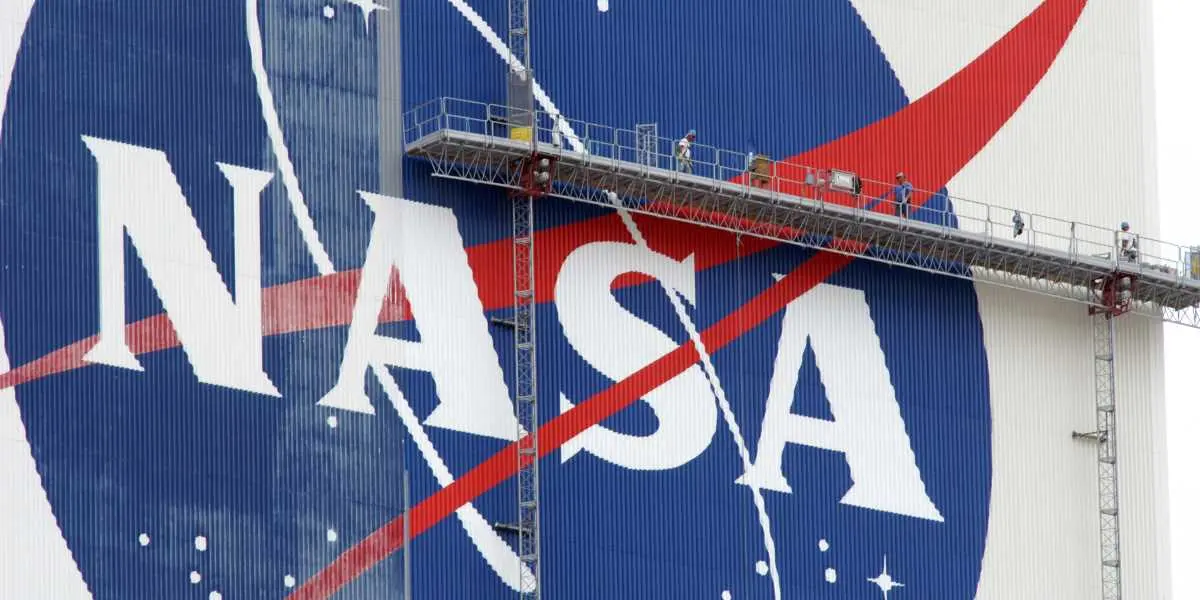
| This year, the United States celebrates a historic milestone: on July 4, it will have been 250 years since the signing of the Declaration of Independence. Fifty years ago, during the nation’s bicentennial, signs of celebration were seen across NASA. In the photo above, the bicentennial logo appears prominently on the Vehicle Assembly Building at NASA’s Kennedy Space Center in Florida. That same logo — designed by Bruce Blackburn, one of the creators of NASA’s iconic “worm” logotype — also traveled to the surface of another body in our solar system. |
| On which of these celestial bodies could you find the bicentennial logo? A. Venus B. The Moon C. Mars D. Ceres |
| Find out the answer in next week’s NASA newsletter! |
 | Last week, we asked how long Alan Shepard’s 1961 spaceflight lasted. The answer? 15 minutes. The Mercury-Redstone 3 vehicle lifted off from Cape Canaveral in Florida at 9:34 a.m. EDT on May 5, 1961, and reached its maximum altitude of 116 miles five minutes later. Alan Shepard’s Freedom 7 spacecraft splashed down in the Atlantic Ocean — 303 miles downrange — 15 minutes and 22 seconds after launch. |
NOTE: This is a NASA publication. Used with permission and formatted to fit this web page.
Great article!