
| In this week’s newsletter, explore new insights into solar storms from NASA’s Parker Solar Probe; hear Artemis II astronauts Reid Wiseman, Victor Glover, Christina Koch, and Jeremy Hansen reflect on their nearly 10‑day, record‑setting mission in a new episode of NASA’s Curious Universe podcast; and learn about NASA Force, a new hiring initiative with the U.S. Office of Personnel Management aimed at recruiting top technical talent for mission‑critical roles. Plus, catch up on additional stories you may have missed. |
| SCIENCE Surprises in an Explosion Near the Sun  |
| Before a solar storm sweeps through space and disrupts technology on Earth, it begins with an explosive process on the Sun called magnetic reconnection. New observations from NASA’s Parker Solar Probe have now revealed fresh details about how these magnetic events accelerate particles to dangerous speeds. During a 2022 solar flyby, the Parker Solar Probe passed between the Sun and a magnetic reconnection site in the solar wind—the constant flow of charged particles and magnetic fields streaming outward from the Sun. Because storm‑generating reconnection typically occurs in the Sun’s difficult‑to‑reach atmosphere, catching an event in the solar wind gives scientists a rare chance to directly measure the particles being accelerated. These new findings will help scientists refine theoretical models of magnetic reconnection and deepen our understanding of how solar storms are powered. MAGNETIC RECONNECTION |
 | SCIENCE Interstellar Glaciers NASA’s SPHEREx, or Spectro-Photometer for the History of the Universe, Epoch of Reionization, and Ices Explorer, mission has mapped interstellar ice at an unprecedented scale. Covering regions in our Milky Way galaxy more than 600 light-years across, the ice was found inside giant molecular clouds—vast regions of gas and dust where dense clumps of matter collapse under gravity, giving birth to stars. MAPPING GALACTIC ICE |
| ARTEMIS Welcome Home NASA’s Artemis II crew returned to Earth on April 10 after a nearly 10‑day, record‑setting mission. The four astronauts traveled farther from Earth than any humans in history, surpassing the distance record previously set by Apollo 13 in 1970. Hear the crew—Reid Wiseman, Victor Glover, Christina Koch, and Jeremy Hansen—share their reactions on the latest episode of NASA’s Curious Universe podcast. LISTEN |  |
 CAREERS AT NASA NASA Force Opportunities NASA Force is a new hiring initiative, created with the U.S. Office of Personnel Management, to recruit exceptional technical talent for mission‑critical roles supporting NASA’s exploration, research, and advanced technology work. LEARN MORE |  SCIENCE Citizen Science Opportunities Join us for a global celebration of public participation in scientific research. NASA invites people of all ages and backgrounds to contribute to real NASA science through projects that rely on volunteers to succeed. Choose a project and new friends, connect with scientists, and help uncover mysteries of the universe—using nothing more than a phone or computer. LEARN MORE |
| More NASA News |
 | As NASA’s X-59 quiet supersonic jet takes to the air, its sleek configuration is now on display thanks to a key milestone it reached in April – flying wheels-up. The transition marks an important step in the aircraft’s testing. |
 | Scientists have discovered that young stellar cousins of our Sun calm down and fade more quickly in their X-ray output than previously thought, according to a new study using NASA’s Chandra X‑ray Observatory. Astronomers used Chandra and other telescopes to monitor how powerful radiation from young stars — often in the form of intense, potentially harmful X‑rays — can bombard nearby planets. Until now, however, they didn’t know how long this high‑energy onslaught lasted. |
 | NASA has approved the agency’s Rosalind Franklin Support and Augmentation project to move into implementation, reinforcing the agency’s ongoing partnership with the European Space Agency on the Rosalind Franklin mission, scheduled for launch in 2028. The Rosalind Franklin rover will be the first to search for signs of past or present life beneath the surface of Mars, marking a major milestone in the exploration of the Red Planet. |
 | Astronomers using NASA’s James Webb Space Telescope to study 29 Cygni b—an object about 15 times the mass of Jupiter that orbits a nearby star—have uncovered multiple lines of evidence showing that it formed through a bottom‑up process, where small bits of rock and ice gradually clump together to build a planet. The discovery offers new insight into how even the most massive planets can take shape. |
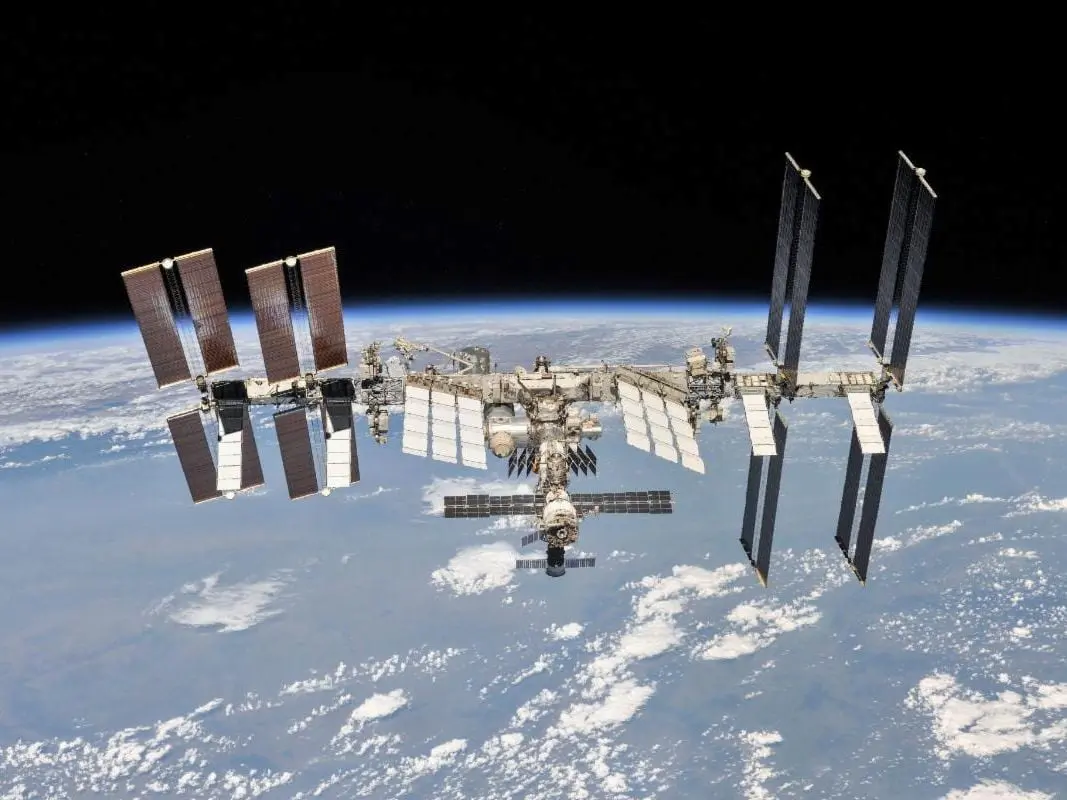
 | No matter how far humanity aims to travel or how ambitious the mission, nutrition will remain essential for crew members living on distant worlds. Before planning long‑term stays on the Moon, Mars, or beyond, we need to learn how to grow and sustain plants to keep future explorers healthy. To tackle this challenge, NASA and its partners are conducting research aboard the International Space Station to understand how the space environment affects organisms critical to nutrition. |
| Do You Know? |
 |
| On April 17, 1967, NASA launched Surveyor 3, a lunar probe that landed in the Moon’s Oceanus Procellarum region three days later. This mission, NASA’s second spacecraft to make a soft landing on the Moon, explored the lunar surface for two weeks, transmitting images of the lunar surface and using a scoop to learn more about the Moon’s regolith. |
| After Surveyor 3’s mission ended, something unusual happened to it. What was it? A. It was hit by an asteroid. B. It fell into a pit after a lava tube collapse .C. It was visited by astronauts. D. It tipped over in a moonquake. |
| Find out the answer in next week’s NASA newsletter! |
 | Last week, we asked how many astronauts have traveled around the far side of the Moon and seen it with their own eyes. The answer? 28. Nine Apollo missions — Apollo 8, 10, 11, 12, 13, 14, 15, 16, and 17 — each carried three astronauts into lunar orbit. Three of those astronauts — Jim Lovell, John Young, and Gene Cernan — made the journey twice. Add the 24 Apollo astronauts to the 4 Artemis II astronauts, and you get a total of 28. |
NOTE: This is a NASA publication. Used with permission and reformatted to fit this webpage.
testing
testing 2