
| In this week’s newsletter, find out where and when to watch US spacewalks 94 and 95; catch up on the latest progress toward the Artemis II mission; and learn how a fleet of NASA missions likely has uncovered a collision between two ultradense stars in a tiny galaxy buried in a huge stream of gas. Plus, more stories you might have missed. |
| HUMANS IN SPACE How to Watch US Spacewalks 94 and 95  |
| On Wednesday, March 18, NASA astronauts Jessica Meir and Chris Williams will conduct U.S. spacewalk 94, exiting the International Space Station to prepare for the future installation of the International Space Station Roll-Out Solar Arrays. NASA’s live coverage will begin at 6:30 a.m. EDT. For U.S. spacewalk 95, two NASA astronauts will continue preparing the orbiting laboratory for a future roll-out solar array installation. NASA will announce the date, time, assigned crew members, and coverage details at a later date. These spacewalks will be the 278th and 279th to support space station assembly, maintenance, and upgrades. They also mark the first two station spacewalks of 2026 and the first of Expedition 74. LIVE COVERAGE DETAILS |
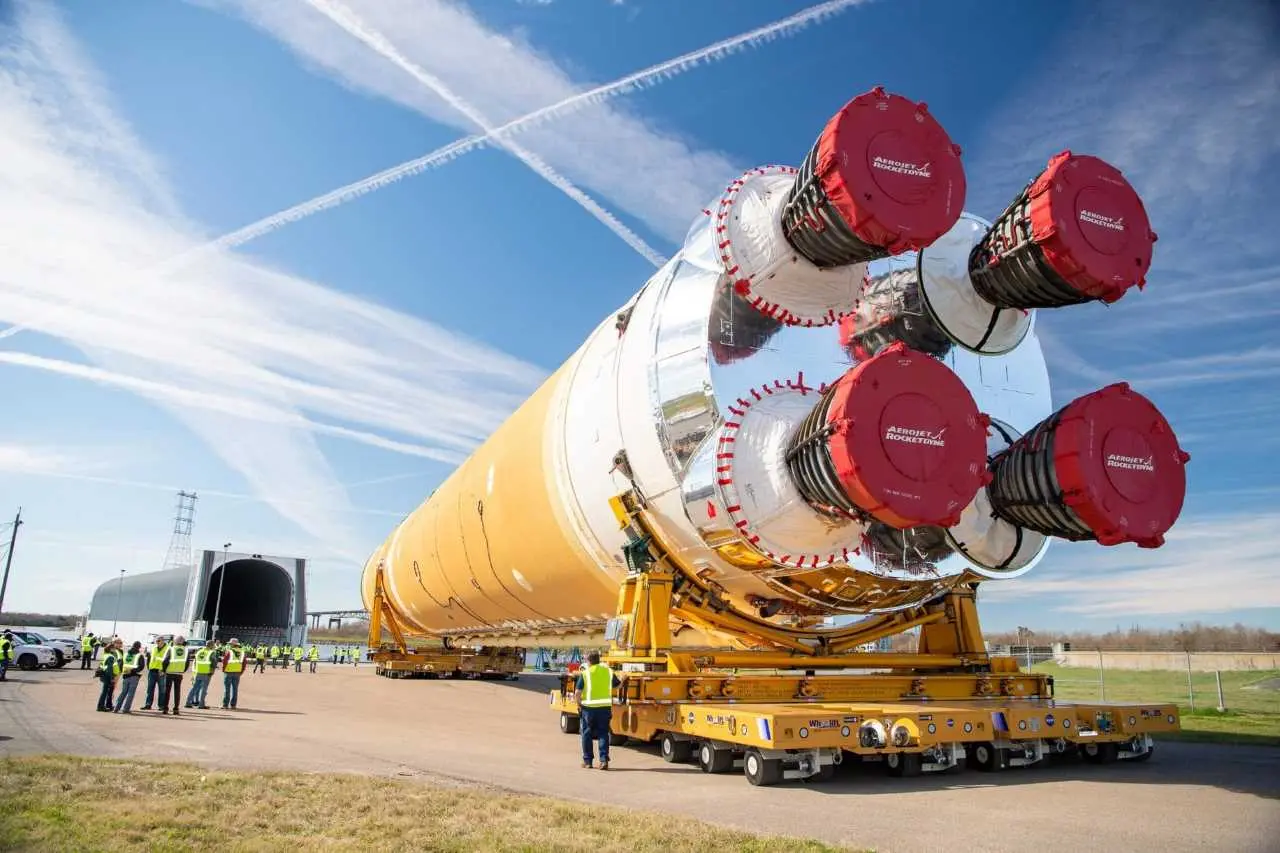
 | ARTEMIS Flight Readiness Polls “Go” NASA completed the agency’s Artemis II Flight Readiness Review on March 12 and gave a “go” to proceed toward launch. The agency is targeting Thursday, March 19, to roll the Space Launch System (SLS) rocket and Orion spacecraft to Launch Complex 39B at NASA’s Kennedy Space Center in Florida, ahead of a planned launch attempt on Wednesday, April 1. ARTEMIS MISSION UPDATES |
| SCIENCE Exploring Titan Integration and testing for the Dragonfly mission are now officially underway at the Johns Hopkins Applied Physics Laboratory in Laurel, Maryland. The rotorcraft is scheduled to launch no earlier than 2028 for a six‑year voyage to Saturn’s moon Titan, where it will explore a variety of sites to investigate the moon’s chemistry, geology, and atmosphere – ultimately helping to advance our understanding of the chemical origins of life. TESTING DRAGONFLY |  |
 SCIENCE Early Re-Entry Van Allen Probe A re-entered Earth’s atmosphere at 6:37 a.m. EDT on March 11, almost 14 years after launch. From 2012 to 2019, the spacecraft and its twin, Van Allen Probe B, flew through the Van Allen belts, rings of charged particles trapped by Earth’s magnetic field, to understand how particles were gained and lost. The belts shield Earth from cosmic radiation, solar storms, and the constantly streaming solar wind that are harmful to humans. LEARN MORE |  SCIENCE Seeing SPARCs With the first images from the spacecraft now in hand, the team behind the Star-Planet Activity Research CubeSat, or SPARCS, is ready to begin charting the energetic lives of the galaxy’s most common stars to help answer one of humanity’s most profound questions: Which distant worlds beyond our solar system might be habitable? LEARN MORE |
| More NASA News |
 | A fleet of NASA missions has likely uncovered a collision between two ultradense stars in a tiny galaxy buried in a huge stream of gas. Astronomers have never witnessed an explosive event like this in such an environment before — and it may help solve two outstanding cosmic mysteries. |
 | After delivering more than 11,000 pounds of supplies, science investigations, and other cargo to the International Space Station, the Cygnus XL spacecraft supporting Northrop Grumman’s 23rd Commercial Resupply Services mission departed the orbiting laboratory at 7:06 a.m. EDT on March 12. |
 | A test replica of NASA’s James Webb Space Telescope’s Optical Telescope Element Pathfinder and a full-scale model of the Parker Solar Probe are now on permanent display at the Smithsonian’s National Air and Space Museum’s Steven F. Udvar-Hazy Center in Chantilly, Virginia. “These missions show what humanity can achieve as we continue to push the boundaries of human knowledge through visionary science,” said Nicky Fox, associate administrator, NASA’s Science Mission Directorate. |
| Do You Know? |
 |
| Saturday, March 14 — Pi Day — is a great day to celebrate circular desserts, but it also is the birthday of greats like physicist Albert Einstein and astronomer Giovanni Schiaparelli. |
| Which of these Apollo astronauts was also born on March 14? A. Frank Borman B. James Lovell C. Walter Cunningham D. Eugene Cernan E. Ken Mattingly |
| Find out the answer in next week’s NASA newsletter! |
 | Last week, we asked which NASA mission former Jet Propulsion Laboratory engineer and program manager Donna Shirley worked on. If you chose any of the options, you were right. In 1995, Shirley became the leader of NASA’s Mars Exploration Program and is best known for her work on the Mars Pathfinder mission, which delivered Sojourner, the first rover to operate on Mars. Her career at NASA’s Jet Propulsion Laboratory spanned 32 years and included contributions to several major missions, including Mariner 10, the spacecraft that flew by Venus and Mercury; Mars Global Surveyor, which orbited Mars for a decade; and Cassini–Huygens, the ambitious mission to Saturn. |
NOTE: This is a NASA publication. Used with permission and formatted to fit this web page.
Still working out why the pictures don’t show up.