
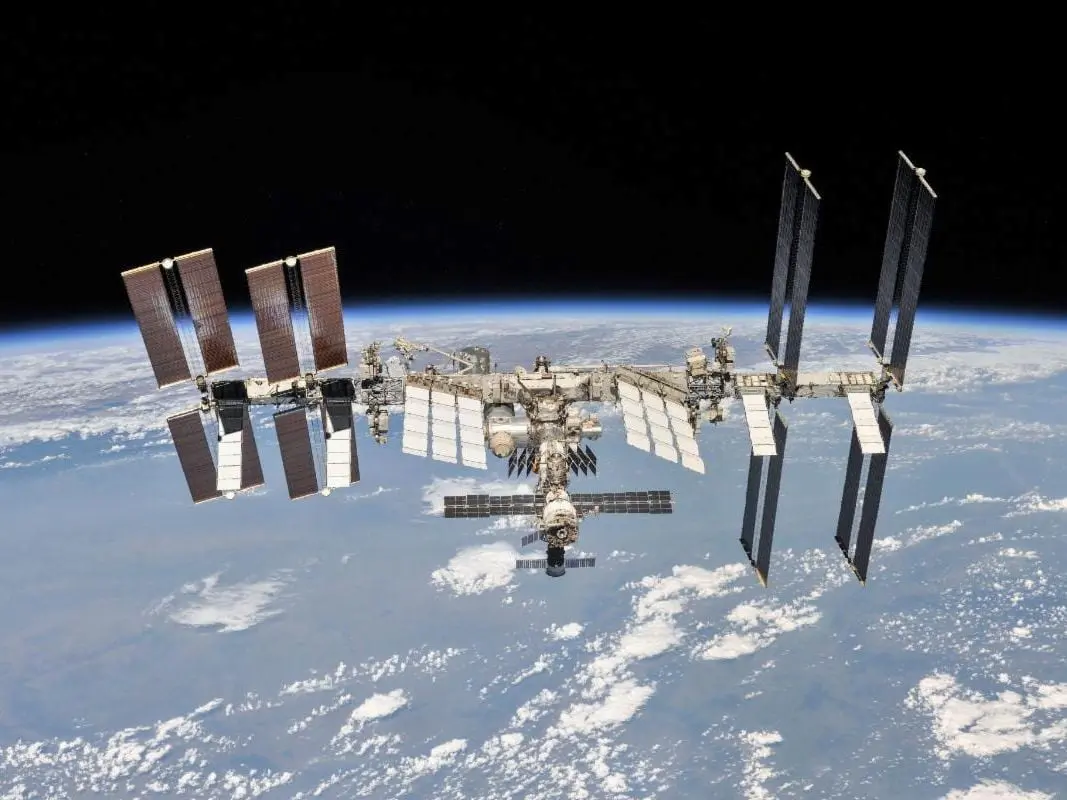
| In this week’s newsletter, discover what a new study reveals about Mars’ Jezero Crater and its enigmatic “Margin Unit”; learn what NASA’s Hubble Space Telescope observed during its 200,000th orbit around Earth; and meet the four crew members of NASA’s SpaceX Crew‑14 mission, who are preparing to launch to the International Space Station for a long‑duration science expeditionn. Plus, more stories you might have missed. |
| MISSIONS Revealing History of Water on Mars |
 |
| When NASA’s Perseverance rover reached the inner edge of Mars’ Jezero Crater in September 2023, mission scientists were surprised by what they found. Called the “Margin Unit,” the geologic area stretches along the shoreline of an ancient Martian lake, so they expected sedimentary rocks, which would have formed as layers of sand piled on top of each other over millennia. Instead, the rover team found igneous rock, which can form deep underground from magma or from volcanic activity at the surface. Igneous rocks are excellent record-keepers, particularly because mineral crystals within them preserve details about the precise moment they formed. In this case, they preserved an astonishingly complex record of water activity on early Mars. In fact, these rocks showed signs of having interacted with water on at least three separate occasions, with each encounter further altering their chemistry and appearance. MARS EXPLORATION |
 | MISSIONS 200,000 Orbits NASA’s Hubble Space Telescope completed its 200,000th orbit around Earth on Sept. 19, marking a major milestone for an observatory that continues to reshape our understanding of the universe. On the day of this landmark orbit, Hubble captured an observation tied to one of its signature scientific contributions: measuring the universe’s expansion rate. The newly released image highlights Hubble’s ability to revisit the same region of the sky over time, enabling astronomers to monitor for the reappearance of a supernova, or explosion of a star, called Athena. HUBBLE OBSERVATIONS |
| PODCAST NASA’s SpaceX Crew-13 On the latest episode of Houston We Have a Podcast, NASA’s SpaceX Crew‑13 — NASA astronauts Jessica Watkins and Luke Delaney, Canadian Space Agency astronaut Joshua Kutryk, and Roscosmos cosmonaut Sergey Teteryatnikov — discuss their paths to becoming astronauts and their upcoming mission to the International Space Station on Thursday, Oct.1. LISTEN |  |
 HUMANS IN SPACE Space Station Research During NASA’s SpaceX Crew‑13 mission aboard the International Space Station, astronauts will support a series of biomedical and human performance investigations, including a new collaborative effort to study how spaceflight affects blood flow and clotting. Before, during, and after flight, astronauts will undergo MRI scans, jugular vein ultrasounds, blood pressure checks, and blood draws so researchers can track changes in blood flow and blood composition. Results will inform preventative measures for at-risk crew members and improve health and safety on future missions. LEARN MORE |  HUMANS IN SPACE Meet NASA’s SpaceX Crew-14Four crew members from three space agencies are set to launch to the International Space Station as early as spring 2027 for a long‑duration science expedition on NASA’s SpaceX Crew‑14 mission. NASA astronauts Kayla Barron and Chris Birch will join JAXA astronaut Makoto Suwa and Roscosmos cosmonaut Arutyun Kiviryan for this journey to low Earth orbit. As the 14th crew rotation mission with SpaceX under NASA’s Low Earth Orbit Program, Crew‑14 will advance a wide range of scientific experiments and technology demonstrations. LEARN MORE |
| More NASA News |
 | An engineering model of NASA’s Deep Atmosphere Venus Investigation of Noble gases, Chemistry, and Imaging descent probe, known as DAVINCI, recently passed a key test at Rex Heat Treat in Bedford, Pennsylvania, showing it can survive the extreme temperatures of Venus. The DAVINCI spacecraft is being developed to travel to Venus to investigate numerous unsolved puzzles, including whether the planet once had oceans and was habitable, like Earth. To explore these mysteries, the spacecraft will release a probe that will withstand hellish temperatures for nearly an hour as it descends through Venus’ toxic atmosphere, collecting data along the way. |
 | Agricultural emissions are a significant yet understudied part of Earth’s land–atmosphere system. NASA’s FarmFlux mission aims to close this gap by deploying more than a dozen sensors to measure ozone, methane, ammonia, particulates, and other pollutants emitted from croplands and animal farms—and how they interact with the atmosphere. Next month, the first series of low-altitude research flights will take place over Colorado. |
 | Arctic sea ice reached its annual minimum on Sept. 12, according to NASA and the National Snow and Ice Data Center at the University of Colorado Boulder. The ice covered an estimated 1.78 million square miles, tying 2008, 2010, and 2025, for the 10th-lowest minimum in the satellite record. Scientists have monitored polar sea ice from space for nearly five decades, maintaining a continuous record with instruments flown on a sequence of NASA and National Oceanic and Atmospheric Administration, or NOAA, satellites. The dataset began with NASA’s Nimbus‑7 satellite, which started observing sea ice in October 1978. |
 | NASA announced the winners of the Deep Space Food Challenge: Mars to Table Thursday, with the top $300,000 prize being awarded to Chinyere Ukeje of Philadelphia for the Adaptive Nourishment Infrastructure food system concept. This competition challenged solvers to explore innovative solutions for integrated space food systems that would provide safe, nutritious meals to astronauts living and working in space. |
 | Following a massive earthquake in July 2025, Russia’s Krasheninnikov volcano erupted for the first time in nearly 500 years. Since then, NISAR, or Indian Space Research Organisation, Synthetic Aperture Radar, satellite has been tracking the ongoing lava flow by capturing high-resolution radar images approximately every 12 days, allowing researchers to compile a detailed time-lapse of the event. |
| Do You Know? |
 |
| Thirty years ago this Saturday, NASA astronaut Shannon Lucid completed her pioneering long-duration spaceflight aboard the Russian space station Mir. Originally planned as a four-month mission, her stay stretched to six months due to shuttle launch delays. When she landed on Sept. 26, 1996, Lucid had spent 188 days in orbit—setting a new spaceflight duration record for both an American and a woman. |
| In what year did a female astronaut surpass Lucid’s space-duration record? A. 2002 B. 2005 C. 2007 D. 2017 |
| Find out the answer in next week’s NASA newsletter! |
 | Last week, we asked what NASA had originally planned to name Enterprise, the agency’s first space shuttle. The answer? Constitution. NASA selected Constitution to honor the nation’s founding document during America’s bicentennial year, and its rollout on Sept. 17, Constitution Day, was no coincidence. Although the first shuttle was not designed to fly in space, it played an essential role in the history of the Space Shuttle Program. Enterprise performed the approach and landing tests that proved the shuttle could glide, maneuver, and land safely. These tests were critical in validating the shuttle’s design before Columbia made the program’s first orbital flight in 1981. |
 |
| Step into the newly reimagined exhibit space at NASA Headquarters in Washington, where space exploration comes to life. Wander through immersive exhibits, get an up‑close look at Apollo and Artemis artifacts, and join in‑person events at the James Webb Auditorium. Then, unwind with a coffee or tea — and maybe a NASA‑themed donut — from the pop‑up café before browsing space‑inspired gifts at the NASA Employee Exchange Store. Whether you’re captivated by today’s cutting‑edge missions or inspired by the history of America’s space program, NASA Headquarters offers a welcoming gateway to explore, learn, and experience NASA up close. |
| Upcoming In-Person Events |
 MON, SEPT. 28 11 a.m. EDT Flight on Other Worlds Explore how flying robots are reshaping planetary exploration in this talk with NASA experts. Learn about Ingenuity, the first helicopter to fly on Mars; meet the new SkyFall trio designed to map subsurface ice and scout the terrain; and look ahead to Dragonfly, a rotorcraft headed to Saturn’s moon Titan to study the chemical building blocks that may have preceded life. REGISTER |  MON–FRI, 8:30 a.m.–5:30 p.m. EDT Earth Information Center Learn how scientists collect and interpret data from a variety of sources to give us the big picture of what we know about our home planet. Explore high-resolution data visualizations, investigate three interactive experiences, and watch short, narrated videos displayed on NASA’s hyperwall. PLAN YOUR VISIT |  MON–FRI, 8:30 a.m.–5:30 p.m. EDT NASA Headquarters Your self-guided adventure begins with hands-on displays that invite you to explore at your own pace—from a replica Mars rover and authentic mission artifacts to interactive exhibits that spark curiosity and reveal something new at every turn. GENERAL INFORMATION |
NOTE: This is a NASA publication. Used with permission and formatted to fit this web page.