
NOTE: This NASA News is a out of order. I missed posting this mid December but adding it now.
| In this week’s newsletter, meet Jared Isaacman, NASA’s 15th administrator; delve deep beneath the volcanoes of Hawai’i with four teams of NASA astrobiologists as they investigate how life might survive in the subsurface of other worlds; and discover what reanalysis of Cassini mission data from 2008 suggests about Saturn’s largest moon, Titan. Plus, more stories you might have missed. |
| ABOUT NASA NASA Welcomes 15th Administrator  |
| Jared Isaacman was sworn in Thursday as NASA’s 15th administrator by District Judge Timothy J. Kelly. The oath was taken during a ceremony held at the Eisenhower Executive Office Building in Washington. As NASA administrator, Isaacman will lead the agency in bold pursuit of exploration, innovation, and scientific discovery. “I am deeply honored to be sworn in as NASA administrator,” said Isaacman. “NASA’s mission is as imperative and urgent as ever — to push the boundaries of human exploration, ignite the orbital economy, drive scientific discovery, and innovate for the benefit of all of humanity. I look forward to serving under President Trump’s leadership and restoring a mission-first culture at NASA — focused on achieving ambitious goals, to return American astronauts to the Moon, establish an enduring presence on the lunar surface, and laying the groundwork to deliver on President Trump’s vision of planting the Stars and Stripes on Mars.” MEET JARED ISAACMAN |
 | ASTRONAUTS NASA Astronaut Lee Morin Retires NASA astronaut and retired United States Navy Capt. Lee Morin has retired from the agency after 30 years of service. He served as a mission specialist on the STS-110 mission and went on to oversee the Rapid Prototyping Laboratory and technology development for the International Space Station, NASA’s Commercial Crew Program, and Artemis campaign. LEARN MORE |
NASA+ ORIGINAL
Our Alien Earth
Delve deep beneath the volcanoes of Hawai’i with four teams of NASA astrobiologists as they investigate how life might survive in the subsurface of other worlds. Inside cavernous lava tubes, these scientists search for microbial life in volcanic rock, analyze subsurface gases, and build an augmented reality model of the field site—all to help advance NASA’s future exploration of Mars and beyond.
NOW STREAMING
 SCIENCE 20 Years, 100,000 Images After nearly 20 years at the Red Planet, the Mars Reconnaissance Orbiter has snapped its 100,000th image of the surface with its HiRISE camera. Short for High Resolution Imaging Science Experiment, HiRISE is the instrument the mission relies on for high-resolution images of features ranging from impact craters, sand dunes, and ice deposits to potential landing sites. Those images help improve our understanding of Mars and prepare for future human missions. LEARN MORE |  THE SOLAR SYSTEM Solving a Black Hole Mystery An international team of astronomers using the Imaging X-ray Polarimetry Explorer, or IXPE, has identified the origin of X-rays in a supermassive black hole’s jet, answering a question that has been unresolved since the earliest days of X-ray astronomy. The IXPE mission observed the Perseus Cluster, the brightest galaxy cluster observable in X-rays, for more than 600 hours over a 60-day period between January and March. LEARN MORE |
| More NASA News |
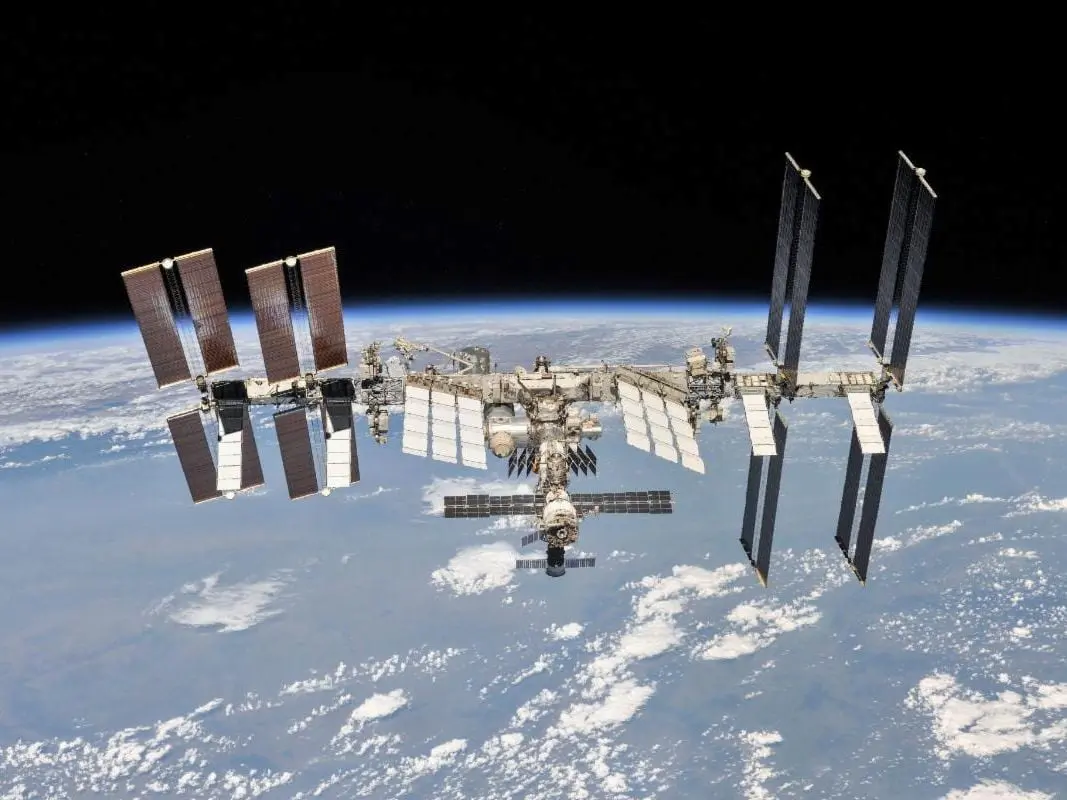
 | This month, NASA en Español’s podcast Universo curioso looks back at 25 years of continuous human presence, collaboration, and science aboard the International Space Station. The episode explores how experiments in microgravity improve life on Earth—from medicine to farming—and help prepare astronauts for future exploration of the Moon, Mars, and beyond. |
 | For the first time, astronomers using the Fermi Gamma-ray Space Telescope have traced a budding outflow of gas from a cluster of young stars in our galaxy—insights that help us understand how the universe has evolved. The cluster, called Westerlund 1, is located about 12,000 light-years away in the southern constellation Ara. It’s the closest, most massive, and most luminous super star cluster in the Milky Way. |
 | A key discovery from the Cassini mission in 2008 was that Saturn’s largest moon Titan may have a vast water ocean below its hydrocarbon-rich surface. But reanalysis of mission data suggests a more complicated picture: Titan’s interior is more likely composed of ice, with layers of slush and small pockets of warm water that form near its rocky core. |
 | Scientists using NASA’s James Webb Space Telescope have observed a rare type of exoplanet, or planet outside our solar system, whose atmospheric composition challenges our understanding of how it formed. Officially named PSR J2322-2650b, this Jupiter-mass object appears to have an exotic helium-and-carbon-dominated atmosphere unlike any ever seen before. Soot clouds likely float through the air, and deep within the planet, these carbon clouds can condense and form diamonds. How the planet came to be is a mystery. |
 | On Nov. 6, the Europa Clipper mission observed the interstellar comet 3I/ATLAS from a distance of approximately 102 million miles. Captured over a period of seven hours, the data gathered by the spacecraft’s Europa Ultraviolet Spectrograph instrument will help scientists determine the composition and distribution of elements in the comet’s coma—the cloud of gas and dust that surrounds its central core of ice and rock. |
| ARTEMIS II Moonbound Artemis II and its upcoming test flight around the Moon will transform plans and preparation into execution and exploration when four astronauts test NASA’s new systems and hardware for lunar exploration for the first time with a crew. Discover what it takes to build this mission from the ground up in the new NASA+ original documentary series, Moonbound. NOW STREAMING |  |
| Do You Know? |
 |
| This week we’re thinking back to Dec. 20, 1968, when astronauts were launched to the Moon for the first time. NASA’s Frank Borman, Jim Lovell, and Bill Anders made history as the first people to be launched into space on the Saturn V mega-rocket and, a few days later, became the first to orbit the Moon. |
| What did the Apollo 8 astronauts witness on their journey? A. The first sunrise on the Moon B. The first Earthrise seen from lunar orbit C. The first lunar eclipse viewed from space D. The first landing of a lunar rover |
| Find out the answer in next week’s NASA newsletter! |
 | Last week, we asked what the name of the first trained geologist ever to set foot on the Moon was. The answer? Harrison Schmitt. On the Apollo 17 mission, Schmitt and Commander Eugene Cernan traveled farther and collected more samples than on any previous Apollo lunar landing mission. While the Apollo missions taught us a great deal about lunar geology, the program’s landing sites were geographically and geologically limited. With Artemis, the opportunity to explore deposits of the Moon’s south polar region will help us understand the region’s sources of water ice and other volatiles, an important step in establishing a future permanent lunar outpost. |
 |
| Do you have a telescope? Would you like to see some of the same night sky objects from the ground that Hubble has seen from space? We invite you to commemorate the Hubble Space Telescope’s 35th anniversary by accepting our yearlong stargazing challenge! New challenge objects will be featured weekly. This week’s object is Messier 77, a large spiral galaxy in the constellation Cetus, the sea monster from Greek mythology. Roughly 45 million light-years from Earth, Messier 77 is one of the largest galaxies in Charles Messier’s catalog. Messier 77 is a prime example of a Seyfert galaxy, a type of spiral galaxy with an intensely active, extremely bright center that is powered by a supermassive black hole accreting matter. With an apparent magnitude of 9.6, Messier 77 is visible in a small telescope and is most easily observed during December. JOIN THE CELEBRATION |
NOTE: This is a NASA publication. Used with permission and formatted to fit this webpage.